Shadows at Jamestown
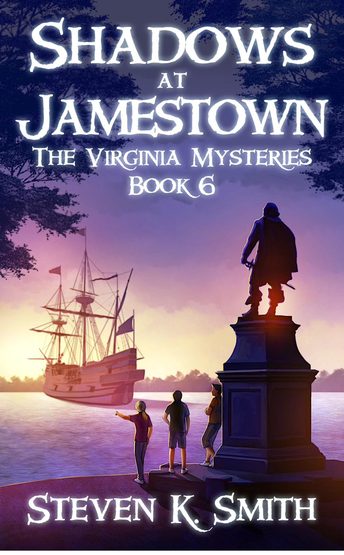
A Virginia Readers’ Choice 2019–2020 Elementary title
Selected by the Virginia State Literacy Association — a statewide list of titles Virginia students read and vote on. Shadows at Jamestown is also the most curriculum-aligned book in the series for the Grade 4 Virginia Studies unit.
Set at the 1607 founding of Jamestown and built around real archaeology, this book pairs naturally with a Historic Jamestowne field trip. The activities below move across reading, primary-source analysis, history, writing, and STEM — each one tied to the Standards of Learning it supports.
Eight ways into the book
“I Found this Humerus” / Creating Puns
ELA · VocabularyOn page 15, Sam and Derek meet a college student whose t-shirt reads “I found this humerus” beside a drawing of a bone — a pun on humerus (an arm bone) and humorous (funny). A pun plays on the multiple meanings or similar sounds of words. Challenge students to write a sentence or joke using each of these homonyms: spring, tire, mean, bark, fair. Writing a working pun shows a clear grasp of word meaning.
Captain Smith Made a Map / Analyze a Primary Resource
Primary SourceThe first map of Virginia was drawn by Captain John Smith, published in England in 1612 and used as the map of Virginia for nearly a century. It records geography and cultural information. Pull up the original at the Library of Congress and compare it with a present-day map of Virginia using these prompts:
- Orientation: Which direction is the Chesapeake Bay? Find the scale (in leagues — one league ≈ 3 miles) and the compass rose. (North is to the right, not the top — Smith drew it from the view of a ship arriving from the Atlantic.)
- The Virginian Sea: Smith labels a body of water “The Virginian Sea.” What do you think it is today?
- Jamestown: Locate the settlement. On which river does it sit?
- Illustrations: Who are the people Smith drew? (Powhatan’s council and a Susquehannock.) Why so many trees?
- Labels: Note Monacans and Powhatan. What do they signify? Smith recorded 200+ Indigenous towns — many names survive in Virginia today.
- Rivers: How many rivers flow into the “Virginian Sea”? (The five largest into the Chesapeake: the Susquehanna, Potomac, Rappahannock, York, and James.)
- More than Virginia: The map covers today’s Virginia, Maryland, Delaware, Pennsylvania, and Washington, D.C. — find them on a modern map.
- X marks the spot: The 27 “crosses” mark places Smith personally visited; the rest came from Indigenous accounts. Locate them.
What If?
Discussion · Cause & EffectProfessor Evanshade explains that the Jamestown settlers nearly abandoned the colony — they were sailing down the river to return to England when they met a supply ship with new colonists, food, and supplies (page 25). Caitlin wonders aloud what would have happened if they hadn’t. History, the professor says, is full of “what ifs.” Ask students: what if the settlers had left for good? Would there have been a Virginia colony? Would others have settled instead?
What Is That Flag?
Primary SourceEach chapter-opening illustration shows Jamestown with an X and what looks like a flag. Use the Zuñiga Map of James Fort — a 1608 sketch smuggled to the Spanish court — to interpret what the drawing actually represents.
Glass House
History · EconomySam, Derek, and Caitlin tour the glass house and watch the settlers make glass (pages 90–93). Glassmaking was one of colonial Virginia’s earliest industries and exports. Recreate their experience with a video of the Jamestown Glasshouse and discuss why the colony needed to produce goods to trade.
There Were 3 Ships
Creative WritingThe kids learn that 71 people sailed on the Susan Constant, 52 on the Godspeed, and 21 on the Discovery — four and a half months at sea in small, cramped quarters. Have students write a journal entry as one of the passengers: what did they eat and drink, what did they see, what did they do for entertainment? This is historical fiction grounded in the book. For scale, the Susan Constant ran about 116 feet bow to stern — measure it out so students can picture the size.
It Is All About the Knots
STEMOn page 105, Jada describes a “log line” used to measure how fast a ship was sailing. Using the description in the book, have students build a log line of their own — and discover why a ship’s speed is still measured in knots.
Jamestown Biopoem
Research · PoetryThe kids perform a play featuring John Smith, John Rolfe, and Pocahontas. Have students research one figure and write a biopoem: first name; two or three describing adjectives; why the person mattered to Jamestown; and so on. (Pocahontas can be researched as a member of the Powhatan nation or in her later life among the colonists.)